The WBG FCV Strategy (2026-2030): Few Wins, Remaining Gaps, and Stripped Accountability
The World Bank Group’s newly released Strategy for Engaging in FCV Settings (2026–2030) marks a significant evolution in how the institution intends to navigate volatile environments, particularly through its shift toward predictive risk modeling and aggressive private-sector mobilization. However, while the framework adopts the language of conflict sensitivity, its operational execution reveals deep systemic flaws. By insulating its predictive methodologies from public scrutiny, prioritizing numerical job quotas over equitable distribution, and failing to establish clear pathways for local ownership, the strategy risks exacerbating the very instabilities it seeks to cure. Most alarmingly, expanding the use of financial intermediaries to support jobs and MSMEs while access to the independent accountability mechanism for financial consumer protection in microfinance has been suspended pending the Sustainability Framework review raises important concerns for vulnerable communities. The following sections outline our core concerns with the approved strategy and the critical gaps that must be addressed to ensure meaningful, conflict-sensitive development.
The Transparency Gap in Risk Classification
On June 8, 2026, the World Bank Group published its approved Strategy for Engaging in FCV (Fragility, Conflict, and Violence) Settings 2026-2030, shifting from a reactive crisis model to a dynamic, predictive classification system designed to spot pressures before conflict hits. The WBG new FCV Country Classification Scheme will divide volatile settings into four main categories: countries at risk of conflict onset, countries affected by conflict, countries in acute crisis and countries in transition. The Bank will continue to make public the indicators and the list of the last two categories; countries in crisis and countries in transition. However, the predictive metrics, data models, and specific thresholds used to place a country on the confidential “at risk of conflict onset or affected by conflict” lists are entirely internal and confidential. The Bank takes the stance that if it makes the forward-looking methodology fully transparent, third-party analysts could backward-engineer the model to figure out exactly which stable countries are on the verge of being flagged. This would trigger the exact market panics, capital flight, and diplomatic fallout the confidential list is designed to avoid.
While we recognize the risks associated with disclosing country-level classifications, confidentiality does not justify opacity regarding methodology.. The strategy does not establish clear safeguards for reviewing the methodology, correcting data errors, testing for bias, or preventing classifications from being shaped by incomplete data, government preferences, or politically convenient interpretations of risk. Nor does it establish a structured role for local researchers, civil society organizations, and affected communities in validating how conflict risks are understood. The Bank could protect sensitive country assessments while still publishing the classification system’s conceptual framework, principal variables, data-quality safeguards, bias-testing procedures, review arrangements, and the ways in which classifications affect financing and programming. The methodology should also be subject to independent review, with aggregate reporting on model performance and mechanisms through which local actors can challenge inaccurate or misleading assessments.
Understanding the Strategy at a Glance
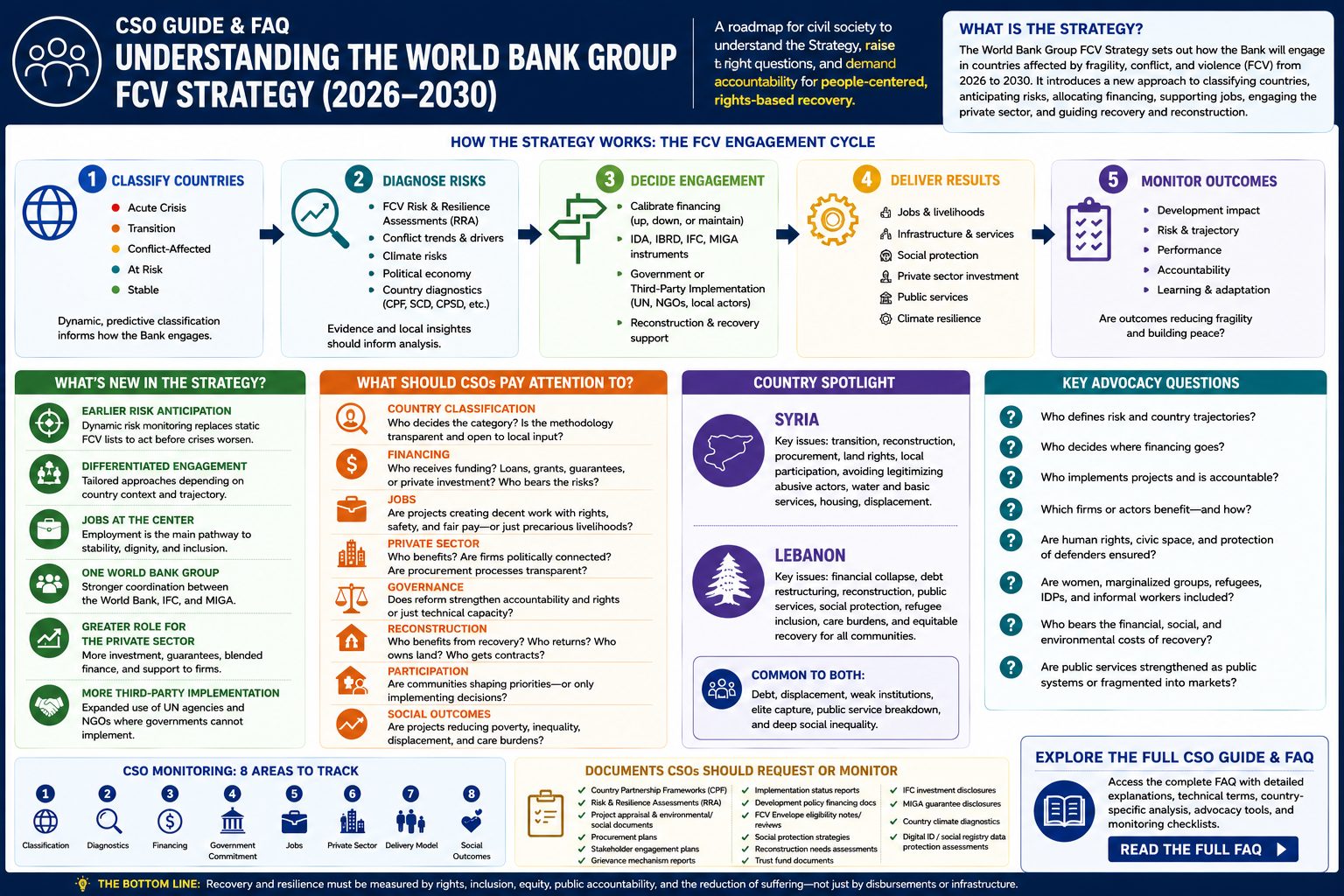
The new country-classification framework is only one part of the World Bank Group’s broader approach. The Strategy links risk classification and diagnostics to financing decisions, implementation arrangements, private-sector engagement, service delivery, and the monitoring of outcomes. The visual below summarizes this engagement cycle and highlights the main questions civil society organizations should raise.
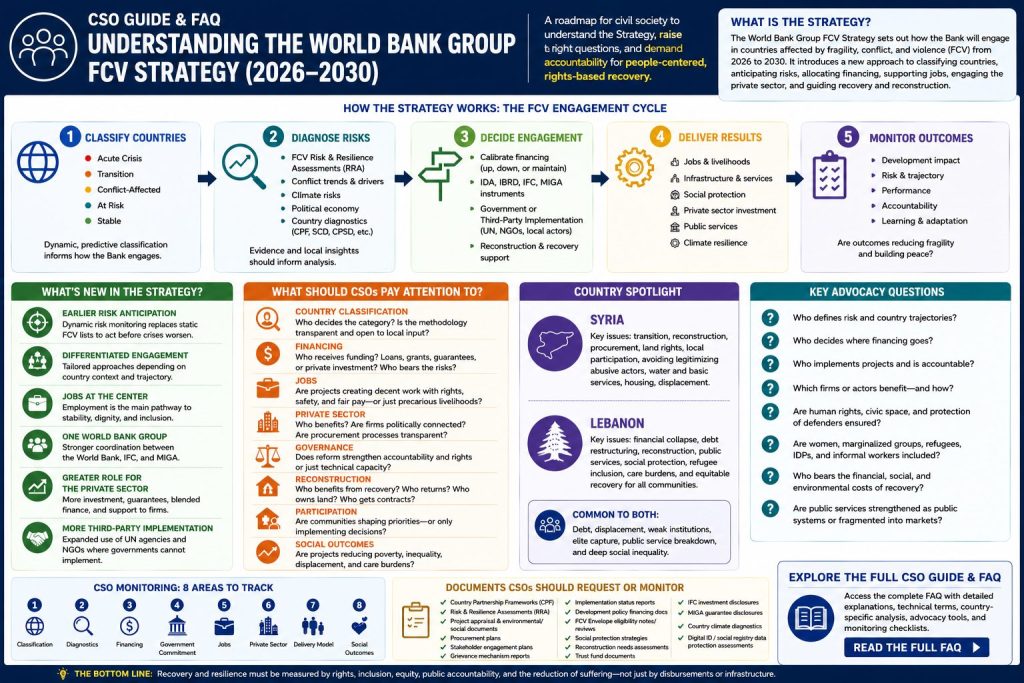 AWC’s visual guide to the World Bank Group FCV Strategy (2026–2030), outlining how the Strategy works, what has changed, and the main issues civil society should monitor.
The Flawed “Jobs” Metric and Accountability Void
The refreshed FCV strategy correctly identifies Jobs, Justice, and Security as the vital legs of stability; however, its actual design remains heavily skewed toward narrow, private-sector-led job creation to reduce poverty. The strategy clearly states that “In line with its mandate and comparative advantage, the WBG will focus on implementing the jobs agenda in FCV-affected settings—as a contribution to a broader effort that also includes political and security components that need to be led by others, within the context of multistakeholder partnerships.”
However, the strategy’s results architecture remains overwhelmingly centred on aggregate job creation and private-sector mobilization..
Jobs are not inherently stabilizing. In divided political economies, employment, procurement, credit, and investment can be captured by politically connected firms, conflict-linked elites, or dominant regions and communities. Aggregate employment figures may therefore conceal whether an intervention is reducing grievances or reproducing the horizontal inequalities that sustain conflict. Conflict-sensitive measurement must assess not only how many jobs are created, but who obtains them, where they are located, under what conditions, and whether their distribution reduces or reinforces existing inequalities. This requires disaggregated indicators covering geography, gender, age, disability, displacement status, ethnicity, and other context-specific lines of exclusion, alongside measures of wages, working conditions, job security, and access to social protection.
Furthermore, we are concerned that one of the financing channels through which the Strategy seeks to support MSMEs—financial intermediaries, including microfinance providers—now faces uncertainty regarding borrower protection. This is particularly important as the World Bank Group expands private sector engagement in fragile and conflict-affected settings, where regulatory oversight is often weakest and affected communities have fewer avenues to seek redress.
This concern is heightened by the Board’s recent decision in the Cambodia microfinance case, which rejected the findings of the Compliance Advisor Ombudsman (CAO), while simultaneously directing CAO to suspend ongoing and future cases relating to financial consumer protection in microfinance pending consideration of the issue during the Sustainability Framework review.
Gender Mainstreaming without a Gender Accountability Framework
Although the strategy promises to embed gender across its work in FCV-affected settings, it does not explain how gender analysis will shape jobs interventions or annual reporting. A general commitment to mainstream gender is not equivalent to an operational framework with measurable outcomes and clear institutional responsibility. Women’s economic exclusion in FCV settings cannot be addressed through job creation alone.
Conflict and reconstruction redistribute unpaid care work, displacement-related responsibilities, income losses, insecurity, and responsibility for injured, disabled, or dependent household members. These constraints determine whether women can access and retain paid employment in the first place. A credible accountability framework should therefore measure not only women’s labor-force participation, but also job quality, wages, unpaid-care constraints, access to childcare and public services, workplace safety, and access to social protection.
Jobs Cannot Substitute for Social Protection and Public Services
The strategy’s jobs-first orientation also marginalizes social protection and public services as foundations of stability in their own right. In acute crises and conflict transitions, formal employment cannot immediately reach displaced people, unpaid caregivers, persons with disabilities, older people, or workers concentrated in informal and care economies. These groups may be among those most affected by conflict while remaining invisible within aggregate employment targets.
Predictable social protection, and specifically healthcare, education, food security, and care services, are not merely complements to job creation. They sustain households during periods of crisis and contribute to institutional legitimacy and social cohesion. The strategy should therefore include measurable commitments concerning the continuity, accessibility, and distribution of essential services and social protection, not assume that private-sector job creation can serve as the principal mechanism for addressing vulnerability.
The Missing Fiscal Dimension
The strategy also inadequately addresses how debt distress and fiscal consolidation shape FCV outcomes. Although it recognizes rising public debt as part of the changing global context, it does not establish how debt sustainability or the financing terms of reconstruction will be incorporated into conflict-sensitive programming.
Mobilizing private capital or financing reconstruction through additional public debt may produce infrastructure and jobs in the short term while creating contingent liabilities and constraining future social spending. Conflict-sensitive engagement must therefore assess who bears the fiscal costs of financing, whether projects intensify debt vulnerabilities, and whether debt-service obligations crowd out social protection, public-sector wages, care infrastructure, and essential services. Without such analysis, the strategy risks supporting interventions that generate visible short-term outputs while weakening the public institutions and services required for long-term stability.
The Over-Reliance on Third-Party Implementers (TPI)
The strategy also fails to address a transition strategy to build and strengthen the local institutional capacity needed for lasting development results. While we applaud the Bank’s willingness to stay engaged in the most difficult contexts through Third Party Implementation (TPI)—mainly UN institutions but also including international and local NGOs—the strategy fails to reform TPI guidance to counter the reality that large international TPIs lack motivation to hand over resources and control to national actors. It did not adopt our call to intentionally build the sustainable capacity of independent, national partners and local organizations to ensure long-term resilience.
The central problem is that current implementation arrangements rarely require international intermediaries to transfer decision-making authority, procurement opportunities, institutional knowledge, data, staff capacity, and financial resources to national actors. As a result, TPI can sustain parallel delivery systems that remain dependent on international organizations rather than strengthening accountable and durable local institutions. TPI arrangements should therefore include binding, time-bound localization and transition plans developed from the beginning of each intervention. The Bank should also report publicly on the proportion of funding reaching local actors directly, the overhead retained by international intermediaries, the allocation of procurement opportunities, and progress in transferring authority to capable national institutions and independent local organizations. Without these requirements, “staying engaged” may preserve short-term service delivery while reproducing long-term institutional dependence.
The Exclusion of Civic Partnerships
As plenty of evidence shows, meaningful engagement with communities and civil society is essential for lasting development results, particularly in FCV settings. The strategy recognizes civil society and local actors as important partners and acknowledges that they often detect emerging stresses earlier than formal institutions. However, this rhetorical recognition is not translated into binding commitments governing when local actors must be consulted, how their analysis will influence country classifications and programming, whether they will receive direct financing, or how participation will be protected in environments characterized by civic-space restrictions and risks of reprisal.
The approved strategy does not require the Bank to consult local civil society organizations during its internal risk monitoring or country-classification assessments. Nor does it establish feedback obligations requiring the Bank to explain how community evidence has informed its decisions.
By treating civic engagement largely as a source of information rather than recognizing civil society as a strategic and decision-making partner, the Bank risks cutting itself off from the actors best positioned to identify emerging conflict pressures and assess the distributional effects of its interventions. A strategy that relies on community knowledge while withholding influence and accountability will continue to produce top-down technical interventions untethered from the lived realities of the people they are intended to support.
The Bottom line: the Strategy needs more accountability
The refreshed strategy contains meaningful advances, particularly its commitment to anticipate risks earlier, remain engaged across different phases of conflict and transition, and recognize the importance of domestic firms, local delivery platforms, and civic partnerships. Yet recognition is not the same as accountability.
Across its classification system, jobs agenda, private-sector operations, third-party implementation, and civic engagement, the strategy expands the Bank’s anticipatory and financial power without creating equivalent transparency, distributional safeguards, local decision-making authority, or access to remedy. Addressing these gaps requires the WBG to publish a clear results and accountability framework containing distributional and conflict-sensitive jobs indicators; gender-responsive and care-sensitive outcomes; social-protection and public-service measures; and assessments of debt and fiscal impacts.
Confidential risk classifications should be subject to independent methodological oversight and structured local validation. TPI operations should contain binding localization and transition plans, while local civil society must have protected, resourced, and demonstrable influence over country analysis and programming. Finally, expanding private-sector and financial-intermediary operations must not come at the expense of access to remedy. Communities affected by WBG-supported activities must retain meaningful access to independent accountability mechanisms, including where harms arise through financial intermediaries and their sub-clients.
Without these reforms, the strategy risks becoming better at anticipating fragility without becoming sufficiently accountable for how the World Bank Group’s own interventions may reproduce it.
For a deeper understanding of the Strategy—including country-specific analysis of Syria and Lebanon, explanations of key concepts and technical terms, advocacy questions, and practical monitoring tools—read AWC’s full CSO Guide & FAQ: Understanding the World Bank Group FCV Strategy (2026–2030). Read the Full CSO Guide & FAQ
Download AWC’s visual guide Click here